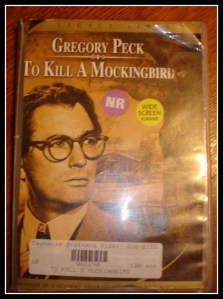
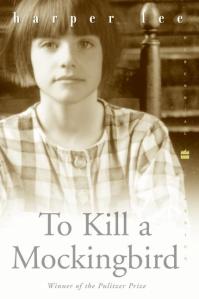
Last week I read and reviewed To Kill A Mockingbird, easily naming this as one of my now all time favorite reads. The book was so well written, so smart, so engaging…. I just fell in love with it and I am so impressed with Harper Lee’s writing style and the story that she tells.
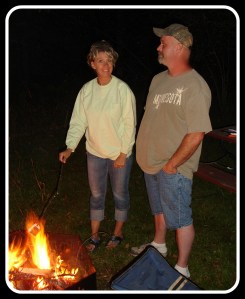
 After finishing the book, I knew I wanted to see the movie and was lucky enough to find it at one of our few remaining video rental stores (uhhh yeah… whats with all the Red Boxes anyway?). I brought the movie with us camping this weekend and watched it with my husband as well as with our company which included two young girls ages 9 and 12. It is fair to say that i was actually a little jealous that they were able to experience this show at the ages they are where I am currently in my 40’s and seeing it for the first time.
The movie was… well, wonderful. Gregory Peck made an incredible Aticus and 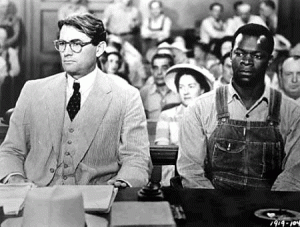 listening to him was just as I had pictured he would be, evenly tempered, wise in his speech, and gentle in his manner. It was wonderful to watch the book come alive before my eyes, and having just finished the book I enjoyed watching how it all played out on the screen.
As in all movies, parts of the book are lost. One of my favorite parts in the book was the end when Scout is walking home in the turkey costume and while that is in the movie, they cut out a lot of the story behind that part of the book, which I missed.
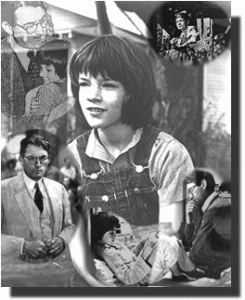 Over all I would highly recommend that everyone first read the book – you will not be sorry, and secondly, watch the movie, both are worth your time and you will forever have this wonderful piece of culture known as To Kill A Mockingbird.
Did you know that To Kill A Mockingbird was a banned book?
Fact: Challenged in Eden Valley, Minn. (1977) and temporarily banned due to words “damn” and “whore lady” used in the novel. Challenged in the Vernon Verona Sherill, N.Y School District (1980) as a “filthy, trashy novel:” Challenged at the Warren, Ind.Township schools (1981) because the book does “psychological damage to the positive integration process ” and “represents institutionalized racism under the guise of good literature:” After unsuccessfully banning Lee’s novel, three black parents resigned from the township human relations advisory council. Challenged in the Waukegan, III. School District (1984) because the novel uses the word “nigger.” Challenged in the Kansas City, Mo. junior high schools (1985). Challenged at the Park Hill, Mo. Junior High School (1985) because the novel “contains profanity and racial slurs:” Retained on a supplemental eighth grade reading list in the Casa Grande, Ariz. Elementary School District (1985), despite the protests by black parents and the National Association for the Advancement of Colored People who charged the book was unfit for junior high use. Challenged at the Santa Cruz, Calif. Schools (1995) because of its racial themes. Removed from the Southwood High School Library in Caddo Parish, La. (1995) because the book’s language and content were objectionable. Challenged at the Moss Point, Miss. School District (1996) because the novel contains a racial epithet. Banned from the Lindale,Tex. advanced placement English reading list (1996) because the book “conflicted with the values of the community.” Challenged by a Glynn County, Ga. (2001) school board member because of profanity. The novel was retained. Returned to the freshman reading list at Muskogee, Okla. High School (2001) despite complaints over the years from black students and parents about racial slurs in the text. Challenged in the Normal, ILL Community High Schools sophomore literature class (2003) as being degrading to African Americans. Challenged at the Stanford Middle School in Durham, N.C. (2004) because the 1961 Pulitzer Prize-winning novel uses the word “nigger.”




 Book Journey