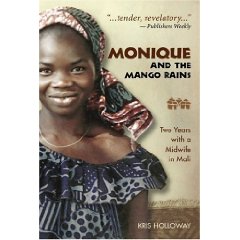
 Monique and the Mango Rains is the compelling story of a rare friendship between a young Peace Corps volunteer and a midwife who became a legend . . .
Monique Dembele saved lives and dispensed hope in a place where childbirth is a life-and-death matter. This book tells of her unquenchable passion to better the lives of women and children in the face of poverty, unhappy marriages, and endless backbreaking work. Monique’s buoyant humor and willingness to defy tradition were uniquely hers. In the course of this deeply personal narrative, as readers immerse themselves in the rhythms of West African village life, they come to know Monique as friend, mother, and inspired woman.
From witnessing her first village birth to the night of Monique’s own tragic death, Kris Holloway draws on her first-person experiences in Mali, her graduate studies in maternal and child health, medical and clinic records, letters and journals, as well as conversations with Monique, her family, friends and colleagues, to give readers a unique view—and a friend in West Africa.
I really enjoy reading about other countries and other cultures. Kris Holloway’s book was a book that fed this hunger for knowledge. Following in Kris’ footsteps this book takes you through her two years she spent in the Peace Corps working with Monique, a midwife in Mali.
The friendship that you witness develop between Kris Halloway and Monique is worth reading the book alone. Yet, there is so much more information to this book them the friendship. This is an accurate account of what life in West Africa was like for this incredible woman.
Day to day Monique wakes early and works all day in the birthing house where she helps women with pregnancies, before the birth, during, and after. Working for unheard of wages that are collected by her husband… this book is one that ripped at my heart. Kris Holloway brings a voice to this remarkable women and brings her story that otherwise would be unknown… to us, the lucky readers. What a privilege to share a part of Monique’s life.
From Kris’s words about Africa, to Monique’s time in America… you will want to experience this book. And that is just what this book is… an experience not to be missed.
Kris Holloway served as a Peace Corps Volunteer in Mali, West Africa from 1989-1991, where she met her husband,
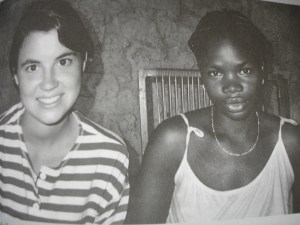
John Bidwell. She holds a MPH from the University of Michigan where she focused her research on maternal and child health. She has used her unique background in writing, public health, and development to further the mission of numerous non-profits and educational institutions including Planned Parenthood, the National Priorities Project, the University of Michigan, Springfield College, and the Greenbelt Movement International. She currently works as the Director of Institutional Relations at the Center for International Studies, a fabulous study/live/explore abroad organization. She is a confirmed Francophile, loves chocolate, and sits on a physio ball while at her computer. She lives in Northampton, MA with John and their two sons.
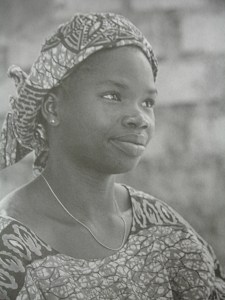
West African Peanut Stew — Tigadegena
(from Monique Dembele, Mali, West Africa, adapted for vegetarians)
Serves 6-8
- 2c. chopped onion
- 3 cloves garlic
- 1tbsp. vegetable oil
- 2 tsp. grated fresh ginger
- 4 c. vegetable stock
- 2 c. tomato juice
- ½ tsp. cayenne (or to taste)
- 1 -1 ½ c. smooth peanut butter
- 2 c. chopped cabbage
- 2 c. chopped sweet potato
- 1 c. chopped okra (if available)
- salt and pepper
- chopped scallions
- Rice or cous-cous (this sauce can be served over either)
- Heat oil in large pot/skillet and fry onions, garlic, and ginger until soft. Add veg. stock, tomato juice, and cayenne. When hot, add peanut butter and mix well. Allow to boil for 10-20 minutes to thicken, then add remaining vegetables. Cook 20 minutes or so until vegetables are soft. Add water if the sauce is too thick, peanut butter if too thin. Serve over rice or cous-cous. Top with scallions. Is even better the next day.
- Traditionally this is served communal-style. A large bowl filled with rice and sauce is placed on the ground. People gather around it and, after washing their hands in a small bowl of water, dig in (each person being careful to only nosh on the rice and sauce directly in front of him/her so as not to mix spit with the folks on either side). Another bowl of water is passed to rinse hands after eating.
- Blessing for after the meal:
Allah ka suma I kono. (May God cool the food in your belly.)
Amina (Amen)
My Amazon Review
This books fits in the following challenges:
This book was given to me by Julie from My Own Little Corner Of The World
Thanks Julie – it was wonderful!













 Book Journey